← Back home
Geotab · Case 01

Ticket reduction through self-serve support

Sole UX designer on a company-wide, COO-sponsored initiative to transform Geotab's fragmented six-system support stack into a single, AI-powered hub. From turning raw Superset data into a costed executive roadmap, through shipping the Central Support Hub, in-app Help panel, and the GIA for Support agent console — to ongoing research shaping Phase 4.

Role
Lead Product Designer (sole UX)
Sponsor
Derek Luke, COO · VP Support Ops
Surface
MyGeotab · support.geotab.com · Agent console
Status
Shipped · Active (Phase 4, 2026)
Strategic context

Six systems, one problem, one designer

Geotab's support ecosystem was — and still is, mid-migration — six independent systems: the Support site, Community, Academy, Dozuki, RightAnswers, and Geotab.com. Users had to guess which one to visit. Support agents had no unified workspace. There was no shared metric, no shared roadmap, and no shared ownership of the problem.

The company launched the Digital Self-Service Support (DSSS) initiative in 2024: a multi-year, COO-sponsored programme to consolidate everything into a single, AI-powered Central Support Hub. I was the sole UX resource across the full initiative — responsible for research, strategy, design, and delivery from Phase 1 through the current Phase 4.

86.0%
CSAT (latest) — down from ~91% in Q1, trending in the wrong direction
−3.6 pts
CES (customer effort score) — the sharpest drop recorded; issues are getting harder to resolve
142/wk
#1 support issue for 12+ consecutive weeks: users don't know their own database name at login
$47.5M
MRR at risk in the permissions/access ticket cluster alone (244 tickets/week)
The problem

The product UX layer is manufacturing support tickets

The conventional narrative blamed hardware and external complexity. The data said otherwise. I pulled ticket volumes from Superset (dashboards 3141 / 4205 / 11412) and the pattern was unambiguous: the MyGeotab UX layer generates nearly as many tickets as all hardware categories combined.

MyG User Management1,804/mo
Drive / Asset / Vehicle1,765/mo
MyG Reporting1,701/mo
MyG Database Management1,409/mo
Device DNC (hardware)1,398/mo
RMA (hardware)1,397/mo

Source: Superset "Top 10 Ticket Trends - MoM" (chart 25825), May 2026. Blue = hardware categories.

On top of the ticket data: a 2023 support survey (544 responses) showed 50% of users unable to find what they were looking for — and 52% of those then contacted human support, cascading a self-service failure directly into operational cost. The same pattern appeared in 2,197 more recent survey responses (Superset chart 64417), including verbatims like: "I have even used outside AI to help with Geotab questions." Users were leaving the product to solve product problems.

"The chat function is poor… I have urgent requests and it's frustrating when there is nobody to assist. I have even used outside AI to help with Geotab questions."

City of Portland · CSAT 50% — Superset Survey Summary (chart 64417), 2,197 responses
Research & discovery

Building the evidence base before touching a frame

The first deliverable wasn't a design — it was a Support UX Insights report: a prioritized, costed breakdown of the support problem that made the revenue-at-risk visible and gave product and operations a shared, fact-based roadmap instead of a wishlist. This became the P0/P1 alignment tool for the entire initiative.

Alongside the data work, I ran a structured research phase covering the user journey, the competitive landscape, and the platform's baseline UX quality.

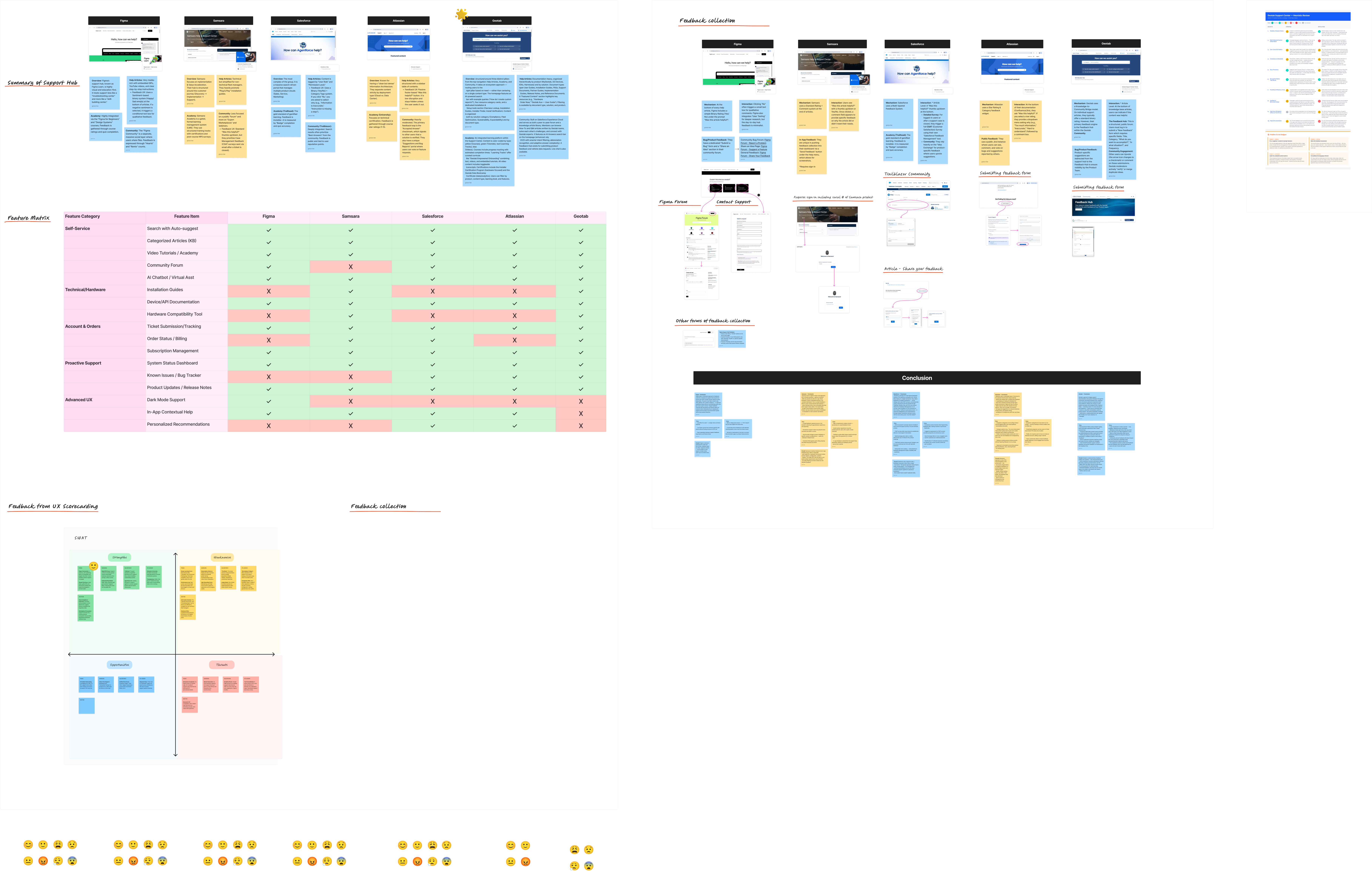
  1. UX Scorecard. Evaluated the Central Support Hub against defined criteria across the full user journey. The verdict: Grade D — a baseline score that gave stakeholders a common reference for "how bad is it?" before anyone could say "it's fine."
  2. Competitive analysis. Built a full feature matrix comparing Geotab's support stack against Figma, Semrush, Salesforce, and Atlassian — across self-service, technical support, account management, proactive support, and advanced UX. Mapped gaps across 18 feature categories. Followed up with an effort/impact prioritization matrix to sequence the work.
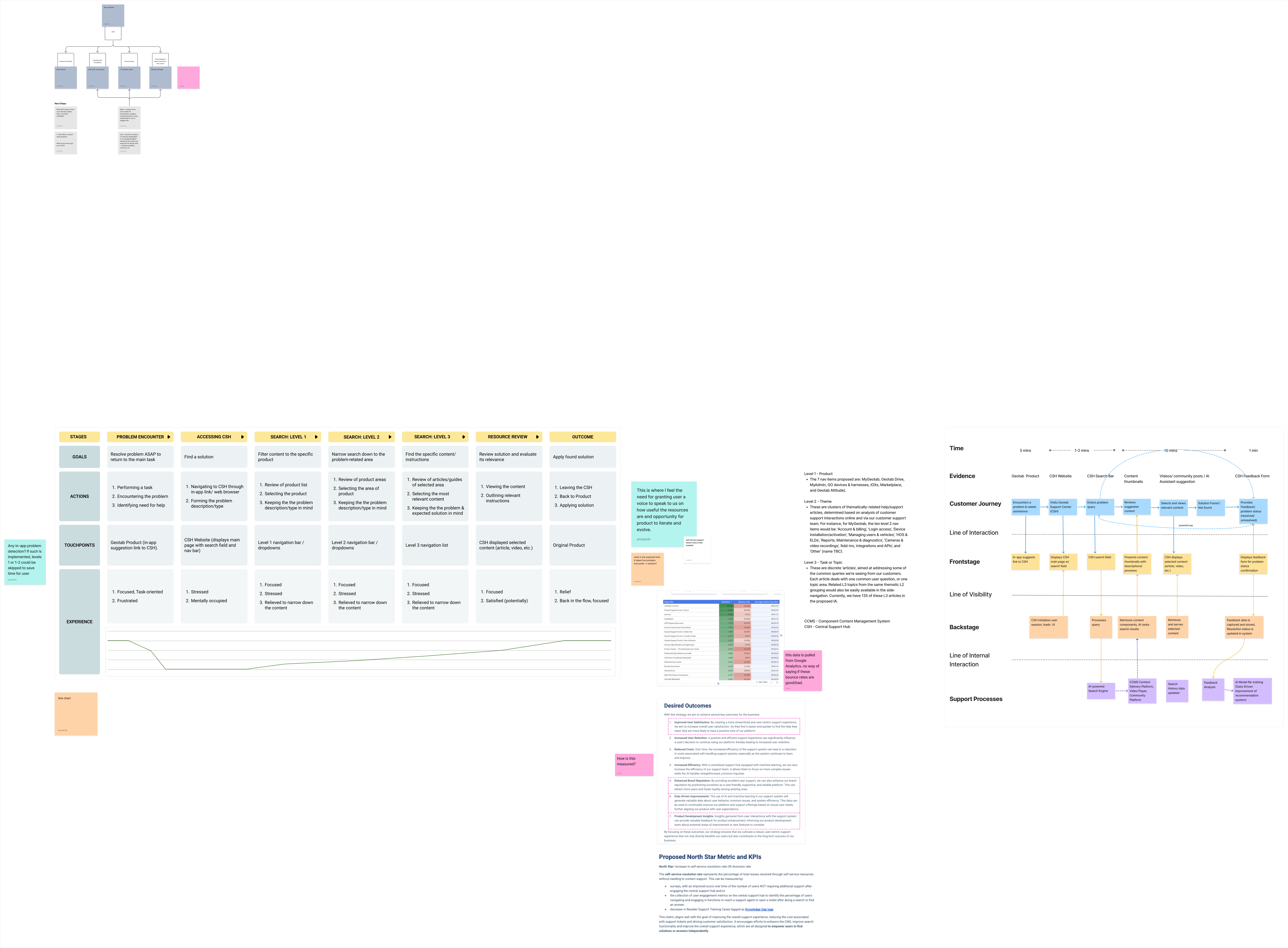
  3. Service blueprint. Mapped the full 7-stage support journey: Problem Encounter → Accessing CSH → Search Level 1 → Search Level 2 → Search Level 3 → Resource Review → Outcome. Across Goals, Actions, Touchpoints, and Experience for each stage, plus Frontstage / Backstage / Support Process layers. Exposed the drop-off points and backstage dependencies that the ticket data couldn't show.
Service blueprint mapping the 7-stage support journey with Goals, Actions, Touchpoints, and Experience rows, plus Frontstage/Backstage layers and a North Star vision on the right
Service blueprint — 7 stages, multi-layer, frontstage/backstage. Became the shared reference frame for prioritization across Support Ops, Product, and Digital Marketing · Service Blueprint.jam
Central Support Hub UX Scorecard showing Grade D rating, Fleet Manager persona card, journey task scoring with emoji ratings, and the full scoring matrix
UX Scorecard — Grade D baseline, Fleet Manager persona, task-by-task scoring with emoji signal ratings · Central Support Hub | UX Scorecard.jam
Competitive feature matrix comparing Figma, Semrush, Salesforce, Atlassian, and Geotab across 18 support feature categories, with effort/impact prioritization matrix below
Competitive analysis — 18-feature matrix across 5 platforms + effort/impact prioritization · Support Hubs - Competitive Analysis.jam
What shipped

Three surfaces, all shipped

1. Central Support Hub — launched January 2026

The support site homepage was redesigned from the ground up into a single, AI-powered entry point. Natural language search ("Describe your issue or ask a question…") replaces the old fragmented navigation. Popular topics surface the top ticket categories (Getting Started, Device Setup, Password Reset) — chosen from the ticket data, not guessed. Resource cards consolidate all six systems (Help Articles, Academy, Community, Known Issues, Development, Installer Finder) into one screen.
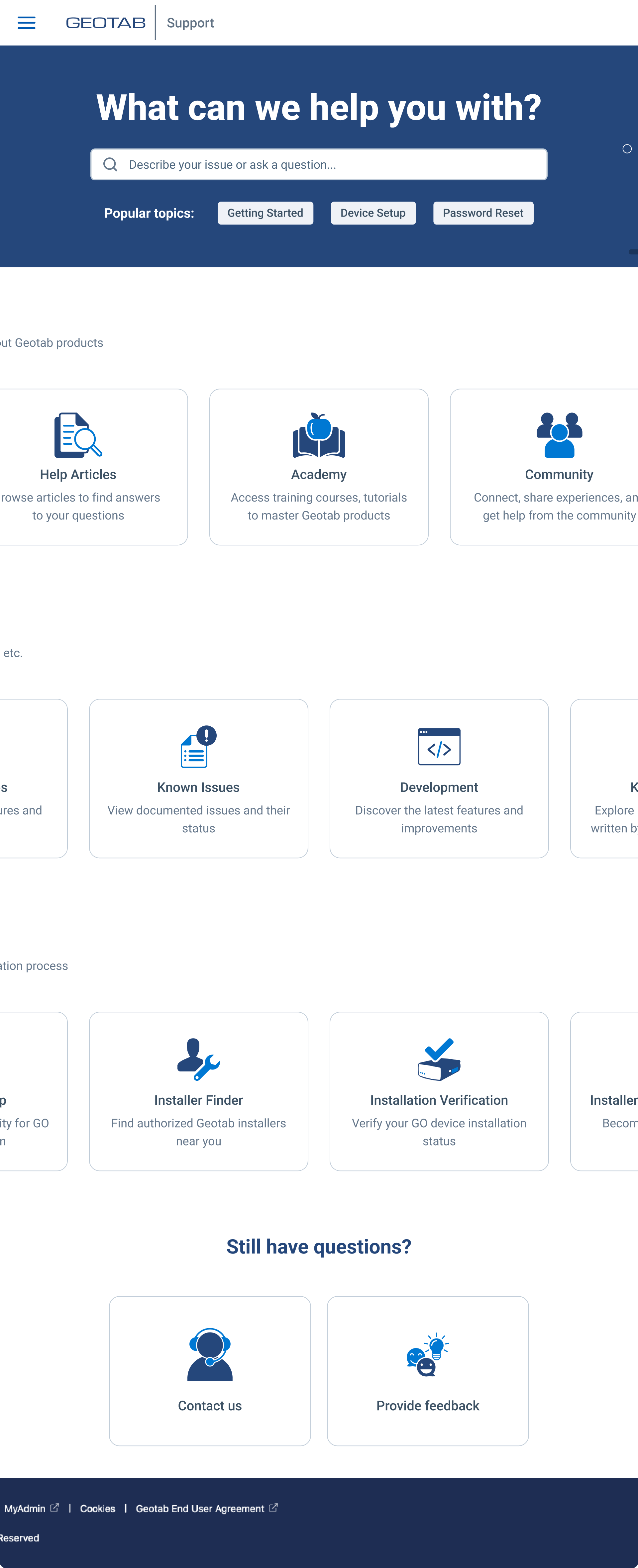

Central Support Hub homepage — launched January 2026 — showing 'What can we help you with?' hero with natural language search, popular topic pills (Getting Started, Device Setup, Password Reset), and resource navigation cards for Help Articles, Academy, Community, Known Issues, Development, and Installer tools
Central Support Hub — live January 2026 · Natural language search, data-driven popular topics, consolidated resource navigation · [DEV] CSH Homepage.fig
Central Support Hub mobile view showing the same natural language search hero and resource card grid adapted for mobile viewport
Mobile — responsive across all viewports · [DEV] CSH Homepage.fig

2. In-app Help panel — contextual support inside MyGeotab

The Help panel slides out from within MyGeotab — no tab-switching, no leaving the workflow. It has two modes: Ask AI (natural language query with suggested prompts contextual to the current page) and Help (curated articles). It surfaces recent conversations, open support tickets, and a direct path to submit a new ticket — all without leaving the application. The contextual prompt suggestions ("How do I create a rule?", "Explain exception rules", "Export data") are generated from the page the user is currently on.
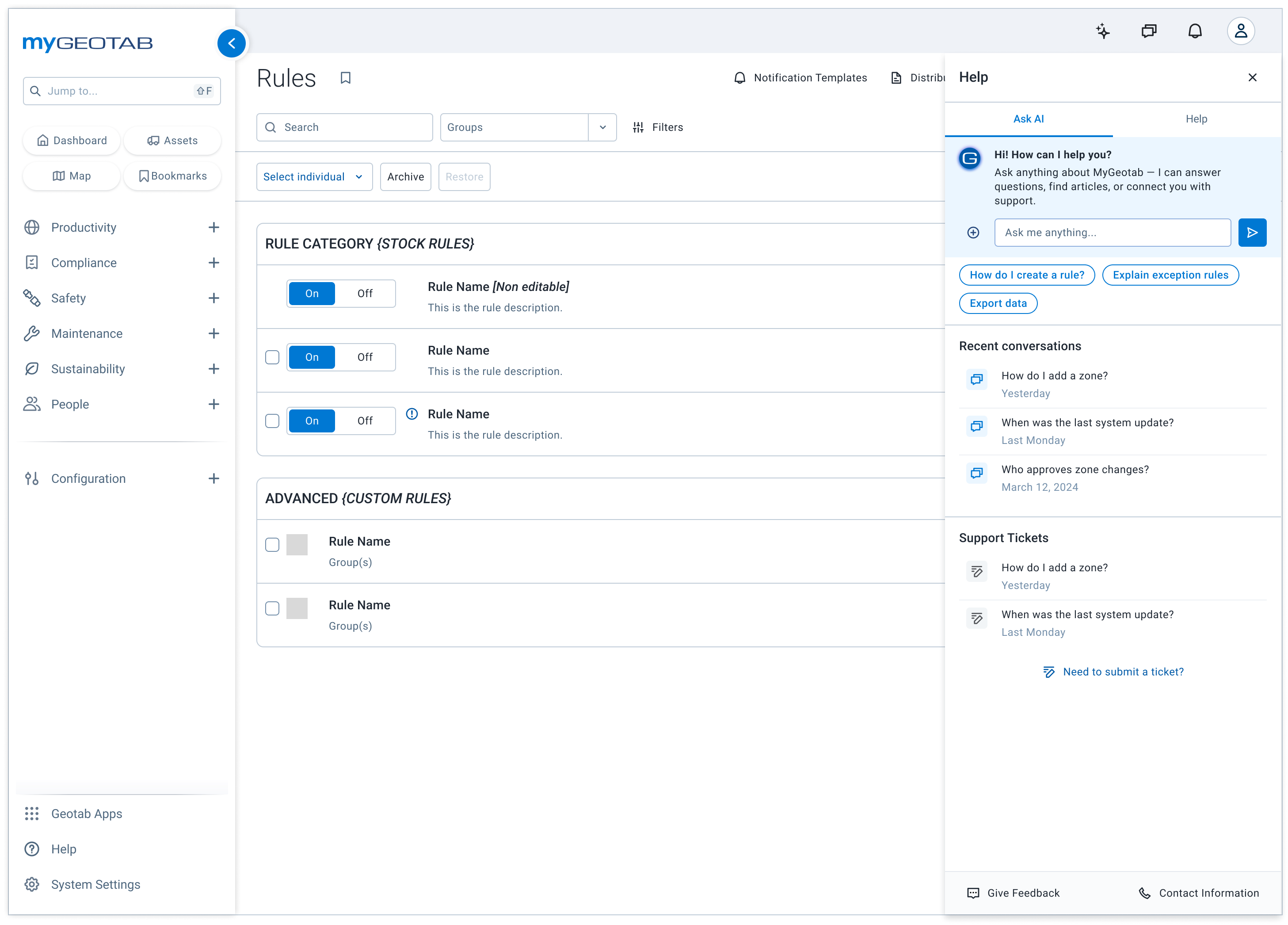
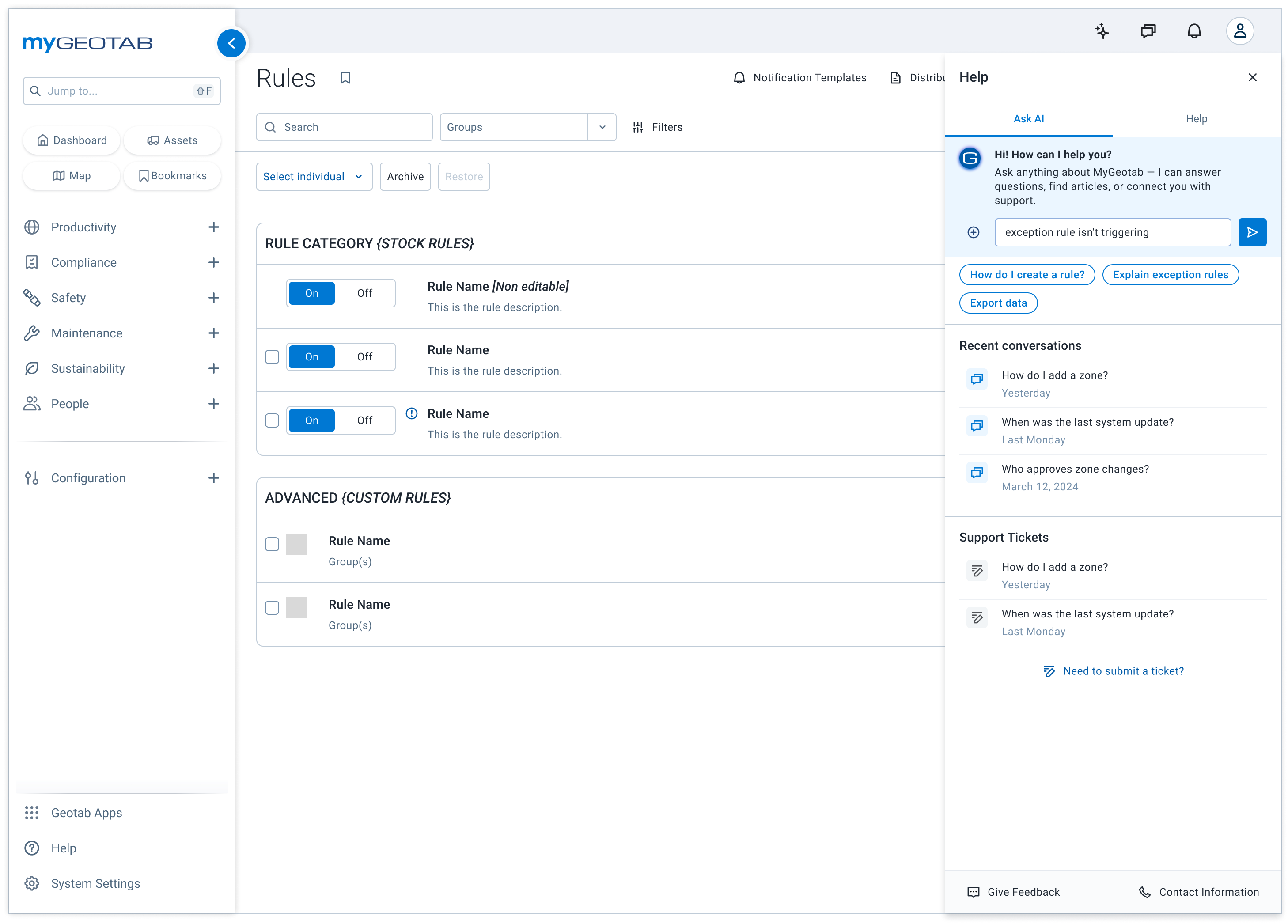
In-app Help panel open inside MyGeotab on the Rules page — showing Ask AI tab selected with 'Hi! How can I help you?' prompt, suggested queries (How do I create a rule?, Explain exception rules, Export data), Recent Conversations, and Support Tickets sections, with Give Feedback and Contact Information at the bottom
In-app Help panel — default state · Ask AI with page-contextual suggestions, Recent Conversations, Support Tickets · In-App Help.fig
In-app Help panel with a user query typed into the Ask AI field: 'exception rule isn't triggering', showing the same contextual prompt suggestions still visible below
Ask AI — active query state, "exception rule isn't triggering" · In-App Help.fig

3. GIA for Support agent console — shipped to all regions

The agent-side of the loop. Before GIA for Support, agents juggled three separate windows (Salesforce, MyGeotab, and the knowledge base) while on a call — copying case details by hand, searching KB manually, and relying on memory for resolution steps. The GIA for Support console replaced that with a single panel: AI-drafted case notes, session-based handle-time tracking, AI-detected safety and priority signals, and the KB surfaced inline. From v1 to v17 across multiple months of iteration with the Support Operations team. Mandatory rollout to all regions.
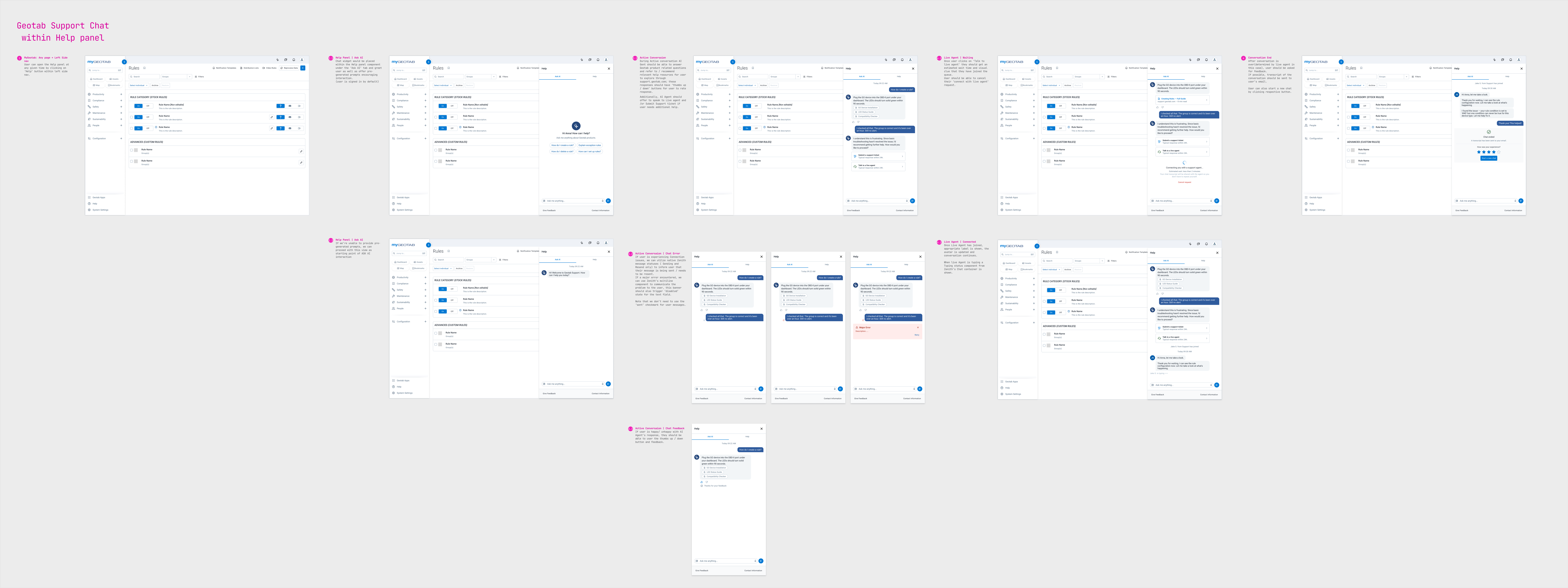
GIA for Support agent console — Ready for Dev — showing 12+ states of the in-app chat experience within MyGeotab including default state, AI conversation flows, ticket creation, escalation handling, and feedback collection
GIA for Support console — Ready for Dev · 12+ states including conversation flow, ticket creation, escalation, and feedback · Geotab Support Chat.fig
Ongoing — Phase 4, 2026

The work continues

The initiative moved into Phase 4 execution in July 2026. The Community migration to the Central Support Hub went live on July 15, 2026, with 15,000+ URLs redirected across 10 languages. Vertex AI Search is being rebuilt across Heretto, Strapi, and Dozuki content pipelines. And I'm running two new research tracks:

Results

A shipped platform, a shared metric, and a live migration

Central Support Hub launched January 2026 — live at support.geotab.com, serving all regions. GIA for Support shipped with a mandatory rollout — all agents, all regions. The Support UX Insights report became the shared, costed P0/P1 roadmap with Support Operations, establishing CES + revenue-at-risk as the joint success metric for support UX — not just a design metric, but an ops metric.

What to watch next: Article-view-to-ticket containment rate for the top 10 ticket topics. CES delta for cohorts exposed to the in-app Help panel vs. those who aren't. GIA skill adoption via Superset dashboards 10739 / 11331 / 10802 + data-genai-usage. "Used outside AI" mentions as a leakage signal — the same verbatim from the 2023 survey, tracked forward. And after the July 15 Community migration: whether community answers resolve questions without escalating to a ticket (the thread that ties Cases 01 and 02 together).